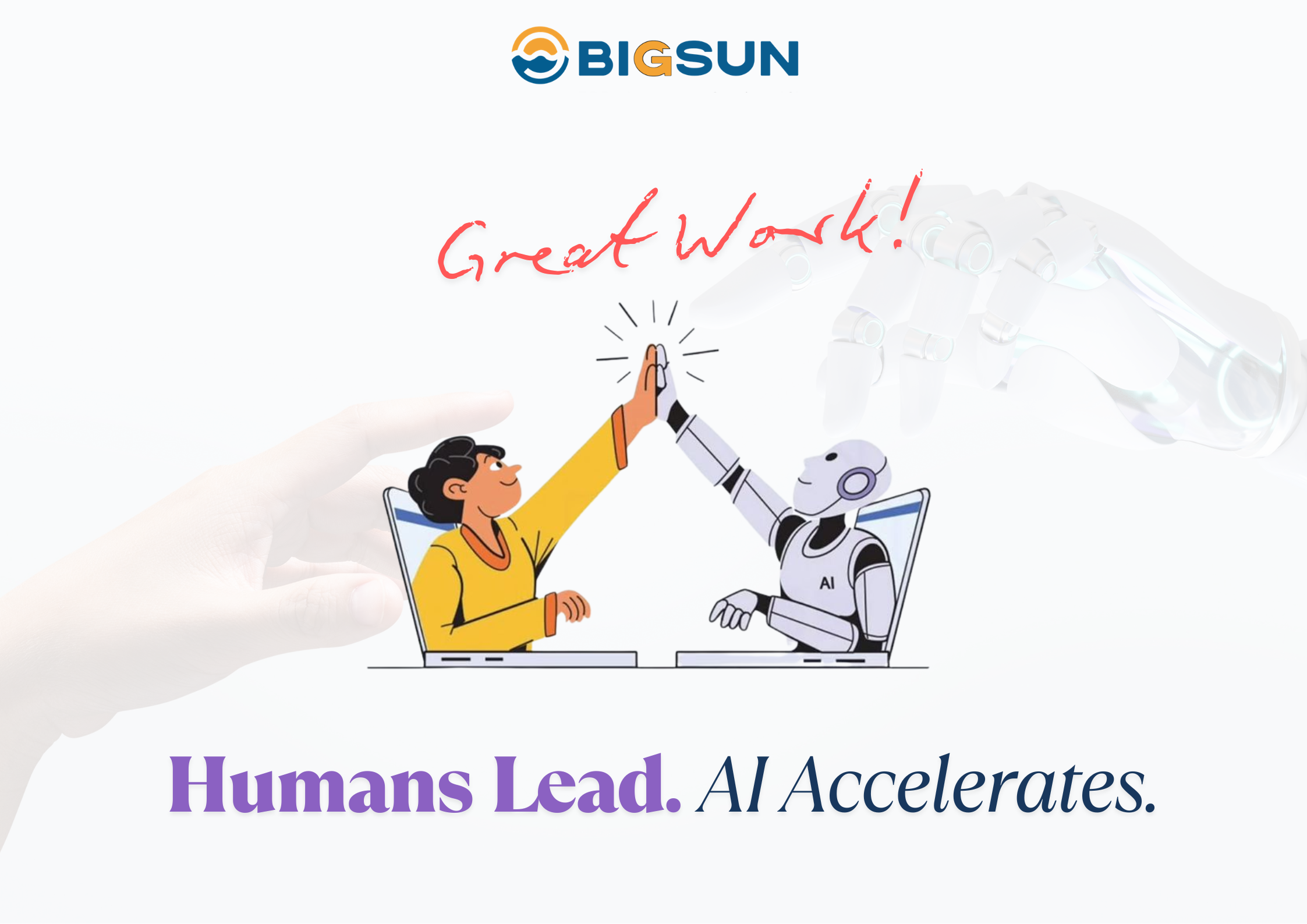
Artificial intelligence is changing how businesses think about enterprise software. ERP systems, traditionally built around recording transactions, managing workflows, and generating reports, are increasingly becoming intelligent systems that can understand data, identify patterns, predict outcomes, and assist users with decisions.
AI-First Does Not Mean Human-Free
The biggest misconception about AI-first ERP is that the goal is to eliminate people from ERP processes.
The better objective is to eliminate unnecessary manual effort.
Employees should not have to spend significant amounts of time:
- Copying information between documents
- Searching through records
- Checking the same information repeatedly
- Preparing routine reports
- Reconciling information manually
- Looking for anomalies across thousands of transactions
AI can increasingly handle these activities.
People can then spend more time on:
- Decision-making
- Problem-solving
- Customer relationships
- Business strategy
- Exception handling
- Approvals
- Managing complex situations
If an ERP becomes AI-first, what should AI do, and what should remain human-led?
The answer is not to make AI responsible for everything.
A well-designed AI-first ERP should combine the strengths of AI with human judgment.
What Does AI-First Mean?
An AI-first ERP means designing ERP processes with artificial intelligence as a core part of the workflow from the beginning.
It is different from simply adding a chatbot or an AI feature to an existing ERP.
A traditional ERP primarily expects users to enter information, follow workflows, search for data, check transactions, and generate reports.
An AI-enabled ERP adds AI capabilities to selected areas.
An AI-first ERP asks a broader question:
"For every ERP process, what can AI understand, automate, predict, validate, or recommend?"
This changes the role of the ERP from being primarily a system of record to becoming a more intelligent system of work and decision support.
A Simple ERP Example
Consider a purchase invoice.
Traditional ERP
A user may need to:
- Open the purchase bill screen.
- Select the vendor.
- Enter the invoice number and date.
- Enter the item details.
- Select applicable taxes.
- Check the purchase order.
- Verify the amount.
- Check TDS or other applicable deductions.
- Submit the transaction.
- Wait for approval.
AI-First ERP
The workflow could become:
- Invoice uploaded
- AI extracts invoice information
- AI identifies the vendor and purchase order
- AI matches invoice values with the PO
- AI validates applicable tax information
- AI checks for unusual or inconsistent information
- ERP prepares a draft purchase bill
- Human reviews and approves
- ERP completes the approved workflow
Instead of making the employee perform every step manually, AI handles the work that involves reading, comparing, checking, and preparing information.
The employee remains involved where judgment and accountability matter.
What Should AI Handle?
AI is particularly useful for activities involving large amounts of data, repetitive work, pattern recognition, and routine validation.
An AI-first ERP could help with:
- Invoice data extraction
- Purchase order matching
- Transaction classification
- Data reconciliation
- Duplicate detection
- Anomaly detection
- Tax validation
- Report generation
- Forecasting
- Ticket classification
- Customer and vendor history summaries
- Draft communication
- Workflow recommendations
- Identifying overdue receivables
- Predicting potential process bottlenecks
The objective is to reduce unnecessary manual effort while improving the information available to users.
What Should Remain Human-Led?
AI can process information quickly, but ERP decisions often have consequences that require business context, accountability, and judgment.
1. Approvals
AI can check whether a transaction follows defined rules and highlight risks.
However, important financial or operational approvals can remain with authorized people.
For example:
AI: "Invoice matches PO and all validation checks have passed."
Human: Reviews and approves the transaction.
2. Financial Decisions
AI can analyze receivables, cash flow, payment patterns, and financial trends.
But management may still need to decide:
- Whether to extend credit
- Whether to release a large payment
- Whether to write off an amount
- Whether to change payment terms
- Whether to pursue a particular customer
AI provides information and recommendations; the responsible person makes the decision.
3. Exceptions
Most ERP processes work well when transactions follow established rules.
The difficult cases are exceptions.
For example:
"The invoice amount is 18% higher than the purchase order."
AI can identify the difference and explain it.
But someone may need to determine whether the difference is:
- A legitimate scope change
- A pricing revision
- An incorrect invoice
- A business-approved exception
AI identifies the issue. Human judgment determines the appropriate action.
4. Tax and Compliance
AI can perform validations and identify potential compliance issues.
For example, it can check whether required information appears to be missing or whether a transaction differs from expected rules.
However, responsibility for important compliance decisions should remain with appropriate people.
5. Customer Relationships
AI can provide a complete picture of a customer's history.
It could summarize:
- Previous orders
- Outstanding amounts
- Support issues
- Payment history
- Recent interactions
But sensitive negotiations, disputes, relationship management, and important customer conversations often require human involvement.
6. Business Strategy
AI can analyze business data and present different scenarios.
For example:
"If receivable days increase by 10%, projected cash availability may decrease."
That information can support management decisions.
But decisions regarding pricing, investments, expansion, budgets, and business priorities remain management decisions.
7. High-Value Transactions
The greater the potential financial or operational impact, the more important appropriate human oversight becomes.
AI can prepare and validate the transaction.
A person can provide the final authorization.
The Human-in-the-Loop Model
A practical way to design an AI-first ERP is:
AI prepares → Human decides → AI executes
For low-risk and repetitive activities, AI may be able to automate most or all of the workflow.
For higher-risk activities, AI can prepare the information and recommendation while keeping a human approval step.
For strategic decisions, AI primarily acts as an intelligence and analysis layer while humans remain responsible for the decision.
This creates a balance between automation and control.
AI-First ERP: A Different Way of Working
The evolution can be viewed simply:
Traditional ERP
Human enters → Human checks → Human decides → Human executes
AI-enabled ERP
Human enters → AI assists → Human decides → Human executes
AI-first ERP
AI understands → AI prepares → Human decides where required → AI executes
The exact level of automation should depend on the risk, complexity, and consequences of the process.
The Future of ERP
The future of ERP is unlikely to be simply about adding more AI features.
The more important change is how ERP systems use AI throughout business workflows.
An intelligent ERP should know when to:
- Automate
- Recommend
- Ask
- Warn
- Escalate
- Wait for approval
- Execute
The goal is not AI versus humans.
The goal is AI and humans working together, with each doing what they are best suited to do.
AI can provide speed, scale, pattern recognition, and continuous analysis.
Humans provide judgment, accountability, context, relationships, and responsibility.
That combination can make an AI-first ERP more useful than an ERP that simply adds an AI chatbot on top of existing processes.
Final Thought
An AI-first ERP should not ask:
"How much work can we give to AI?"
A better question is:
"Which parts of this process should AI handle, which parts should AI assist with, and where should a human remain responsible?"
That distinction is what can turn AI from an add-on feature into a meaningful part of the ERP experience.
AI prepares. Humans decide. AI executes.