
10 Reasons Your Manufacturing Business Needs an ERP
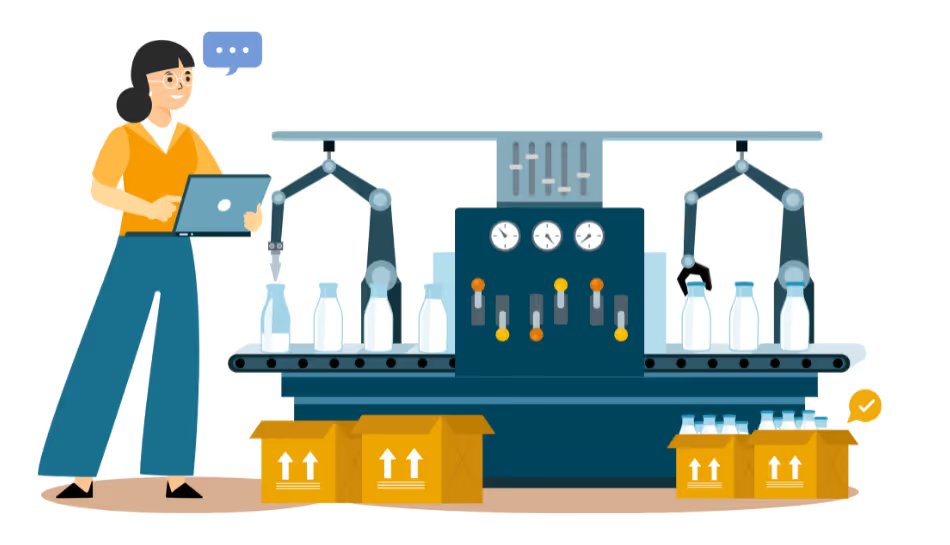
Running a manufacturing company is never an easy task. With the amount of raw material procurement, production, inventory management, finance, and order reception involved, things can go awry rather quickly if there is a lack of connectivity. This is exactly where an ERP solution can act as a game-changer. With the help of a manufacturing ERP solution, things do not go awry.
Below are 10 ways that ERP will save your production business and help you perform better:
-
1. Reduces Operational Costs
One of the most important advantages of using ERP systems is cost control. ERP systems eliminate duplicated efforts and thus help in cutting down on unwanted spending. The manufacturers will have better control over their expenses and thus will be able to curtail wastage. -
2. Enhances Inventory Management
The ERP system monitors the levels of the inventory in real time. In this way, it is impossible to have an overflow of products in stock and a lack of products in stock, as well as scrambling to get additional products at the end of operations since this comes with extra costs. Improving existing products and optimizing your inventory helps you be more organized. -
3. Minimizes Production Delay
With an ERP system in place, the process of production planning will improve. Using the system, you will be able to schedule jobs and track their completion in real time. -
4. Improves Financial Accuracy
Handling accounting manually sometimes results in inaccuracies. One of the most important strengths of ERP solutions is the ability to handle financial management effectively. ERP software helps in effective costing, budgeting, and accounting, and in producing accounts through a single source. -
5. Increases Employee Productivity
ERP can automate many similar recurring tasks, such as entry of data into reports and orders. As such, employees can pursue other functions, thus increasing productivity. -
6. Enhances Decision Making
ERP offers real-time dashboard analysis. With such analysis of sales, production, inventories, and financial data, it becomes easier for a firm to take proper decisions. It has significantly impacted the use of ERP in manufacturing. -
7. Consolidates Supply Chain Management Control
ERP integrates suppliers, storage facilities, and production personnel under a single system. This makes everything more coordinated and eliminates delays resulting from lack of communication and data consistency. -
8. Guarantees Improved Quality Control
Quality problems can be costly. ERP solutions make it easier to manage quality checks throughout the manufacturing process. This helps minimize defects, reworks, and customer complaints. Quality management. All operations link to inventory. Controlling all aspects of inventory is critical. So organizations must monitor inventory levels. -
9. Enables Business Scalability
As more manufacturing businesses are established, the more difficult it is to cope with complexity. Scalability is one of the advantages of ERP systems in the long run because ERP grows along with the business without requiring changes to the system. -
10. Increases Customer Satisfaction
When orders are accurately tracked, deliveries are faster, and there's improved communication, satisfied customers are the end result. The use of ERP software enables manufacturers to ensure that all customer expectations are met, which has a direct effect on customer retention and building a positive brand name.
Why ERP Makes Sense in Manufacturing
The benefits of using enterprise resource planning extend beyond technology. In this case, enterprise resource planning brings transparency and synchronization among various departments in a company. This makes manufacturers competitive within a rapidly changing environment.
Contemporary ERP systems, such as the Bigsun ERPs that are dedicated to the production sector, address all the aspects that a production entity requires, including inventory management, production planning, accounting, human resource management, and reporting.
Final Thoughts
The benefits of an ERP system to companies that manufacture and want to maximize efficiency are self-evident. Whether it is cost savings and increased productivity to improved planning and customer satisfaction, it’s an area where the benefits of the software are hard to ignore. Thus, when investing in the ERP system, the manufacturer enhances processes not only within the organization but also creates a better platform for growth.