
UPI MDR Changes from 15 October 2026: What Merchants Need to Know
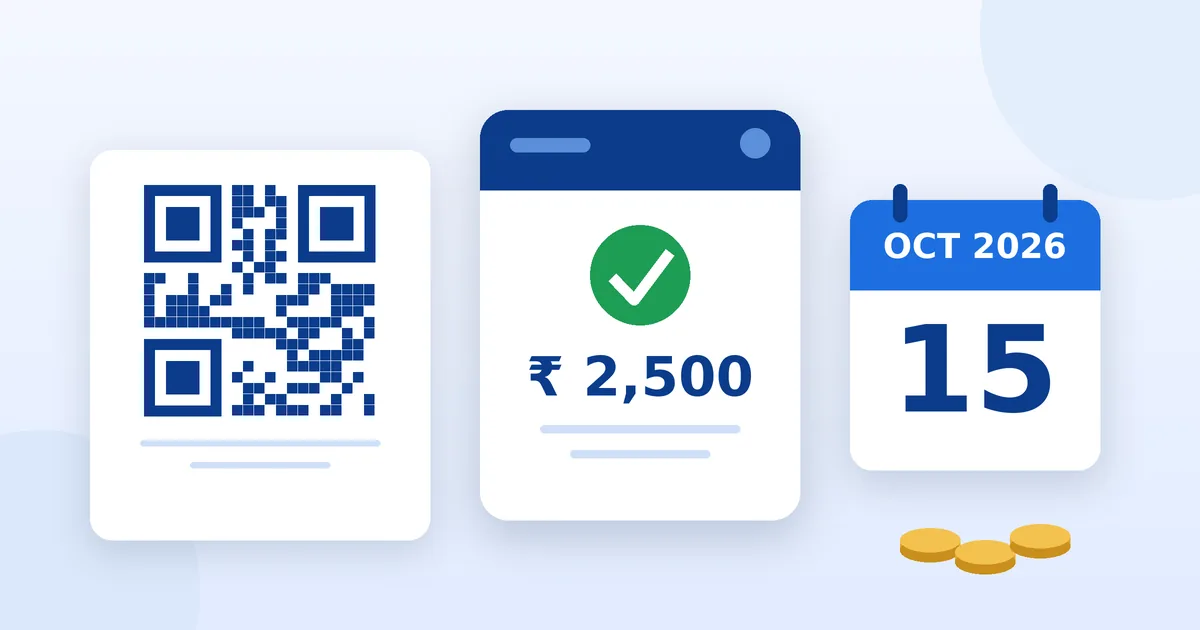
UPI has become so much a part of everyday business in India that scanning a QR code and seeing a payment confirmation almost feels like handing over cash.
But for merchants, there is an important change coming into effect from 15 October 2026.
A revised UPI MDR (Merchant Discount Rate) framework will apply to eligible Person-to-Merchant (P2M) UPI transactions above ₹2,000. For eligible standard merchant transactions, the MDR will be 0.40%, subject to the applicable rules and limits.
15 October 2026
0.40% MDR
on eligible P2M UPI transactions above ₹2,000
- Who bears it
- Merchant-side charge
- Customers
- No separate UPI surcharge should be passed on to customers
The important part? This is a merchant-side charge. Customers should not be charged a separate UPI surcharge for it.
So, what exactly is changing, and what should businesses be prepared for? Let's break it down without the usual payment-industry jargon.
First, what is MDR?
MDR stands for Merchant Discount Rate. In simple terms, it is a fee associated with accepting a digital payment. It is generally borne by the merchant and forms part of the economics of the payment ecosystem.
For merchants, the practical question is much simpler:
"If a customer pays me through UPI, will the amount I receive be affected?"
For eligible transactions covered by the new framework, the answer can be yes from 15 October 2026.
What changes in UPI MDR from 15 October 2026?
From 15 October 2026, an MDR of 0.40% will apply to eligible P2M UPI transactions above ₹2,000, subject to the applicable guidelines and merchant category. In rupees, it works out like this:
| Transaction Amount | Example MDR at 0.40% |
|---|---|
| ₹3,000 | ₹12 |
| ₹10,000 | ₹40 |
| ₹50,000 | ₹200 |
Illustrative calculations before applicable taxes or other charges. Actual commercial treatment is subject to the applicable framework, merchant category and service-provider terms.
What about payments of ₹2,000 or less?
This is where one of the biggest misconceptions can arise.
The revised framework does not mean that every UPI payment will suddenly attract a charge. Payments to merchants up to ₹2,000 remain under the zero-MDR framework, along with eligible transactions covered by the applicable small-merchant provisions. Person-to-person (P2P) UPI transfers are not part of this change and remain free.
Approximately 96% of P2M UPI transactions are expected to remain unaffected. So if a customer pays ₹500, ₹1,000 or ₹2,000 to an eligible merchant, the new MDR framework does not automatically mean an MDR charge on that transaction. For most day-to-day sales, the question of UPI charges above ₹2,000 simply does not come up.
And what about customers?
This is perhaps the most important point for businesses to understand.
The MDR is a merchant-side charge. It should not be added to a customer's bill as a separate "UPI charge" or UPI surcharge. For customers, UPI continues to remain a convenient way to pay without a separate UPI transaction charge under this framework.
That distinction matters. A merchant accepting a ₹10,000 eligible UPI payment may have a payment-processing cost associated with the transaction, but that does not mean the customer should suddenly see an additional UPI fee on the invoice.
Does GST apply?
GST should not be confused with a tax on the UPI transaction itself.
Where applicable, GST may be charged on payment processing fees, MDR and other relevant service charges according to the prevailing tax treatment. For merchants using a payment service provider, the exact treatment will depend on the applicable commercial arrangement and tax rules.
Businesses should therefore look at the actual settlement and fee structure provided by their payment service provider rather than assuming that GST is being charged on the UPI payment itself.
What about other payment methods?
The revised UPI MDR framework does not automatically change the commercial terms of every payment method. Existing pricing for other payment modes will continue to apply according to the relevant payment provider and merchant agreement.
That means businesses should continue to review their overall payment mix rather than looking at UPI in isolation.
A small change that businesses should not ignore
For a single transaction, 0.40% may not look significant. But businesses rarely process one transaction.
Imagine a merchant processing hundreds or thousands of higher-value UPI payments every month. Even a small percentage can become a meaningful operating cost when multiplied across transaction volume. This is why the change is worth understanding before it appears in settlement reports.
The question is not simply:
"What is the MDR percentage?"
The better question is:
"How many of our UPI transactions will actually fall within the applicable MDR category?"
That is the number finance and business teams should watch.
What should merchants do before 15 October?
There is no need to panic or change the way customers pay. Instead, businesses should take a few practical steps.
1. Review your UPI transaction mix
Look at the number and value of your UPI transactions above ₹2,000. This will give you a much better idea of the potential impact than looking at the MDR percentage alone.
2. Understand your settlement reports
Make sure your finance team knows where applicable MDR and other payment-processing charges will appear in settlement reports.
3. Check your payment provider's commercial terms
Payment aggregators and payment service providers may communicate specific implementation details, settlement treatment and applicable charges.
4. Do not add a separate UPI surcharge to customers
The MDR is a merchant-side cost. Businesses should not simply add it to the customer's invoice as a separate UPI payment charge.
5. Keep your accounting and reconciliation process ready
For businesses processing large volumes of digital payments, even small changes in transaction costs can affect reconciliation and profitability reports. This is where having a clear payment-to-settlement reconciliation process becomes particularly useful.
If your team still matches settlements by hand, it is worth checking how your ERP software handles payment reconciliation. Our explainer on accounting and finance modules in an ERP system covers what to look for.
What is changing for CCAvenue merchants?
CCAvenue will implement the applicable UPI commercial changes with effect from 15 October 2026, in accordance with the relevant guidelines.
Merchants using CCAvenue should review the applicable communication, settlement reports and commercial terms shared with them to understand how the changes will reflect in their transactions.
The bigger picture
UPI has changed the way India pays. From small neighbourhood purchases to large business transactions, digital payments have become part of everyday commerce.
The introduction of a revised MDR framework for selected higher-value merchant transactions is therefore more than just a pricing update. For businesses, it is a reminder that payment methods are also part of operating costs, and that UPI merchant charges now belong in that picture.
The good news is that the change is targeted rather than universal. Most merchant UPI transactions are expected to remain unaffected, while customers continue to use UPI without a separate surcharge under the framework.
For merchants, the smartest approach under the UPI MDR 2026 changes is simple:
Understand your transaction mix, understand your settlement costs and prepare before the change takes effect.
In short
From 15 October 2026:
- Eligible P2M UPI transactions above ₹2,000 may attract 0.40% MDR, subject to applicable guidelines.
- The MDR is a merchant-side charge.
- Merchants should not pass the MDR to customers as a separate UPI surcharge.
- Payments up to ₹2,000 covered by the applicable zero-MDR framework remain unaffected.
- P2P UPI transactions remain free.
- GST, where applicable, relates to relevant payment-processing fees and charges and should not be confused with a GST charge on the UPI payment itself.
- CCAvenue will implement the applicable commercial changes from 15 October 2026.
For merchants, this is not a reason to rethink UPI. It is a reason to understand the numbers behind it.
The earlier you understand your payment mix, the easier it is to plan for the change.
Note: Payment charges, eligibility, exemptions, caps and tax treatment are subject to applicable guidelines and the commercial terms applicable to the merchant. Merchants should refer to the latest communication from their payment service provider for transaction-specific details.