
How LOS Software Helps NBFCs Reduce Loan Approval Turnaround Time
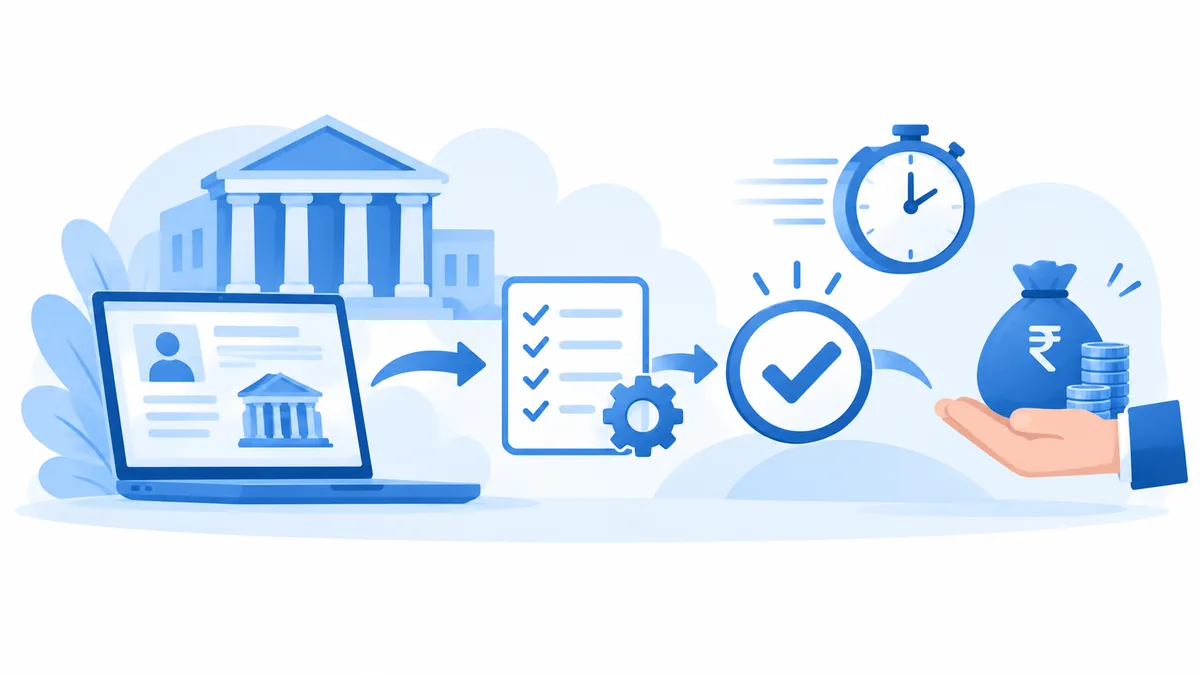
For an NBFC, a loan application that takes too long to process can mean more than an unhappy customer. Applicants may approach another lender, documents pile up, and employees spend hours following up on applications instead of processing new ones. The pressure grows when the NBFC handles hundreds or thousands of applications across branches and lending products.
A Loan Origination System (LOS) addresses this by bringing application intake, document collection, verification, credit assessment and approval into one managed workflow. This guide explains how LOS software for NBFCs reduces loan approval turnaround time, which capabilities matter most, and what to look for when selecting one.
What is LOS software and how does it reduce loan approval turnaround time?
Loan Origination System (LOS) software manages the loan application process from submission to approval. It captures applicant details, collects and checks documents, applies lending rules, supports credit assessment and routes each case to the right approver. Turnaround time falls because repetitive manual steps, such as re-keying data, chasing missing documents and passing files between teams, are automated or removed.
Loan turnaround time (TAT) is the time between a complete application being received and a credit decision being communicated. Reducing it does not mean rushing credit decisions or relaxing verification standards. It means removing waiting time between steps.
Challenges NBFCs face in traditional loan processing
When applications are handled through emails, spreadsheets and paper files, delays tend to build up at every stage:
- Incomplete application forms and missing documents.
- Manual data entry across multiple systems.
- Delays in income and identity verification.
- Repeated follow-ups between departments.
- Slow credit assessments and unclear approval ownership.
- Poor visibility into pending applications.
Even a straightforward application can take longer than necessary in this environment, and managers cannot easily see where files are stuck.
How LOS software streamlines loan origination
A LOS connects the stages of origination so that information entered once is reused at every later step. The table below compares a typical manual process with a LOS-supported one.
| Stage | Manual process | With LOS software |
|---|---|---|
| Application intake | Paper or emailed forms keyed in by staff | Applicant details captured digitally in a structured format |
| Documents | Physical files and email attachments | Documents uploaded and stored against the application |
| Verification | Manual checks and follow-ups | Verification supported by configured checks and integrations |
| Eligibility | Officer applies policy by hand | Application checked against predefined lending rules |
| Approval | File passed between people | Case routed to the right approver by workflow rules |
| Tracking | Status requested by phone or email | Status visible on a common dashboard |
This is the core of loan processing automation and digital loan origination: the same lending policy, applied with less manual effort and fewer handovers.
Automated borrower document verification
Document-related delays are one of the most common reasons applications stay pending. A digital LOS allows applicants to submit documents electronically, and employees can open them from the application record instead of searching through files or inboxes.
Depending on the system and its integrations, document checks can be supported by digital document processing and verification tools. The system can also flag a missing or unreadable document early, so the applicant is asked once, at the start, rather than after the file has moved through several desks. Verification teams can then spend their time on cases that need judgement.
Automated eligibility assessment
Every NBFC has lending rules: minimum income, age limits, loan-to-value ratios, existing obligations, product-specific conditions. Automated eligibility assessment checks applicant information against these predefined rules as soon as the data is available.
An application that meets the conditions can move to the next approval stage, while one that falls outside them can be flagged for manual review or declined according to policy. Officers no longer have to calculate eligibility by hand for every case, and the rules are applied consistently across branches.
Credit scoring and risk assessment
Credit assessment looks at an applicant's financial position, repayment capacity and credit history. When this information is scattered across systems, staff spend time collecting and comparing it before any analysis begins.
A LOS can bring the relevant information into one view and support the assessment through configured scoring models and risk rules. A credit score is a numerical indicator of a borrower's credit risk. Using one, along with the NBFC's own risk parameters, helps teams reach quicker and more consistent decisions. Complex or borderline cases can still be routed to a credit officer. For more on the underwriting step, see our article on loan underwriting.
KYC and credit bureau integrations
Know Your Customer (KYC) checks and credit bureau reports are standard parts of lending. Done manually, they involve switching between portals and copying details across. With integrations, a LOS can retrieve relevant borrower information directly into the application, reducing manual verification and the chance of transcription errors.
Which KYC services and credit bureaus a particular system can connect to depends on the product and its configuration, so NBFCs should confirm the specific integrations they need before choosing a vendor. Our guide to customer onboarding automation for NBFC software covers the front end of this process in more detail.
Real-time loan application tracking
Without a shared view, the usual way to find an application's status is to ask someone. Real-time application tracking shows where each application sits, who holds it and how long it has been there.
- Loan officers can see pending tasks and follow up on delays.
- Managers can spot bottlenecks by stage, team or branch.
- Applicants can be given accurate updates without internal enquiries.
Alerts for pending tasks help ensure no application waits unnoticed.
Reduction in manual errors and processing delays
Manual data entry creates errors: a wrong digit in an income figure, a missing field, a mismatched name. Automated data validation helps identify missing information and incorrect entries when the data is entered rather than at a later review stage, when correction is slower. Workflow rules also cut idle time by assigning each application to the right team, whether verification, credit or branch approval, so cases do not wait for someone to decide who should pick them up.
Benefits of LOS software for NBFCs
- Shorter turnaround: fewer manual steps and handovers between application and decision.
- Consistency: lending rules applied the same way across branches and products.
- Better accuracy: validation at the point of entry reduces rework.
- Visibility: managers see volumes, pending cases and processing times.
- Scalability: teams can handle higher application volumes without a proportional rise in manual effort.
- Audit trail: activity recorded against each application supports reviews and compliance checks.
Important features to consider when selecting LOS software
The table below lists the main areas to evaluate. Ask vendors to demonstrate each one with your own loan products rather than a generic example.
| Area | What to check |
|---|---|
| Automation | Digital application capture, document handling, rule-based eligibility and workflow routing |
| Integration | KYC and credit bureau connections, plus links to your loan management and accounting systems |
| Configurability | Ability to set your own lending rules, scorecards and approval hierarchies per product |
| Scalability | Handling more applications, users and branches as the business grows |
| Security | Role-based access, data protection and activity logs |
| Reporting | Dashboards on pending cases, turnaround time, approvals and rejections |
Our comparison articles Best Loan Origination System and How to Choose the Right Loan Origination System go deeper into the selection process.
How LOS, loan management and NBFC ERP fit together
A LOS handles the journey from application to approval. A loan management system (LMS) takes over after disbursement: EMI schedules, repayment tracking, overdue management and closure. An NBFC ERP ties these to finance, accounting and compliance so the same data supports lending operations and reporting. When these parts share data, a sanctioned loan flows into servicing and accounting without re-entry. Read more in Features and Benefits of Loan Management Systems, and see how post-disbursement automation works in our companion article on automating EMI schedules, interest calculations and repayment tracking.
Conclusion: faster decisions, better lending operations
Reducing approval turnaround time is about removing unnecessary manual work and making sure every application reaches the right person at the right time, while keeping control over credit quality. A well-implemented LOS gives NBFCs a more organized, transparent and responsive lending process.
Bigsun Technologies' NBFC ERP software is built for NBFCs and covers loan origination, disbursements, risk rating and compliance. If you would like to see how these workflows could work for your lending products, book a demo or contact our team. You can also explore our wider ERP software and financial accounting software.