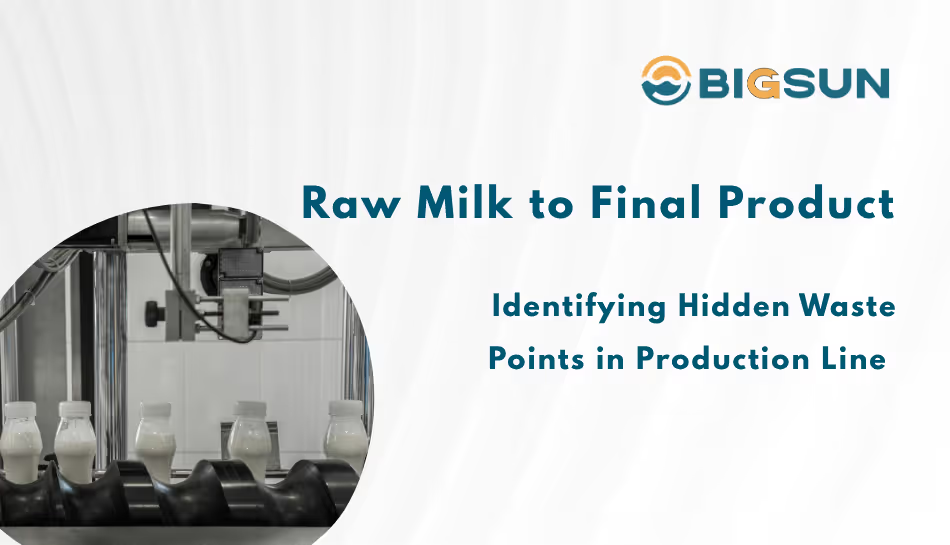
In dairy manufacturing, waste rarely shows up as a dramatic spill or breakdown. Instead, it hides in small, repeated inefficiencies across your production line. A few liters lost here, a slight overfill there... and suddenly, thousands of liters disappear every month.
The key is not just reducing waste, but knowing exactly where it’s happening. Once you uncover these hidden loss points, improving profitability becomes much easier.
Why It Matters
Milk loss directly impacts your bottom line. Even a small loss rate of 1–2% can translate into massive financial losses in high-volume plants.
On a larger scale, industry estimates suggest that up to 4% of milk can be lost due to inefficiencies, significantly affecting profitability and sustainability.
Understanding the impact of milk loss on dairy plant profitability is the first step toward building a more efficient operation.
Key Milk Shrinkage Points in Dairy Processing
Waste occurs at every stage, from intake to packaging. Here are the most common milk shrinkage points in dairy processing:
- Raw Milk Reception
Losses begin as soon as milk arrives. Leaks in connections, faulty valves, and inaccurate flow meters can lead to discrepancies between received and recorded quantities. - Transfer and Pumping
Improper pump settings can cause foaming or cavitation, leading to product loss during transfer between tanks. - Processing Stage
Pasteurization, separation, and homogenization often result in losses due to equipment inefficiencies, residue buildup, or process errors. - Cleaning and Changeovers (CIP)
Frequent cleaning cycles flush out residual milk in pipelines. Poor production scheduling increases these losses significantly. - Packaging and Filling
Overfilling, spillage, and defective packaging can account for up to 0.5–1% of total production losses.
How to Identify Hidden Waste Points
To effectively optimise dairy inventory and reduce waste, you need visibility across the entire production line.
Here’s how leading plants approach raw milk reception waste analysis and beyond:
- Use mass balance tracking to compare input vs output at every stage
- Monitor real-time flow data across equipment and pipelines
- Analyze batch-wise losses during processing and changeovers
- Track rejected or returned products from packaging lines
- Maintain detailed reports to identify recurring inefficiencies
Without proper tracking, many plants underestimate their actual losses.
Key Features to Look For in Milk Loss Tracking Software
The best milk loss tracking software should go beyond basic reporting. Look for:
- Real-time monitoring of milk flow and usage
- Automated alerts for abnormal losses
- Detailed batch tracking for greater transparency and traceability
- Integrated with manufacturing and inventory systems for improved coordination
- Data-driven analytics to reveal patterns and emerging trends
Modern, automated systems significantly reduce avoidable losses compared to outdated manual processes.
Top Tools for Tracking and Reducing Dairy Waste
If you are evaluating solutions, here are some top options:
- 5. Zoho Inventory
A basic solution for small-scale tracking, but limited for detailed production loss analysis. - 4. Tally ERP
Useful for accounting and simple inventory, though not designed for deep waste tracking. - 3. SAP Business One
Offers strong ERP capabilities with customizable tracking for dairy operations. - 2. Oracle NetSuite
Provides advanced analytics and real-time monitoring for large-scale manufacturing environments. - 1. Bigsun ERP
Built for industry-specific needs, Bigsun ERP stands out with advanced milk loss tracking, real-time monitoring, and powerful analytics. It helps identify hidden waste points, supports dairy inventory management, and improves ROI of automated dairy processing lines through better visibility and control.
Advantages of Reducing Hidden Waste
- Improved profitability through reduced product loss
- Better resource utilization across production
- Minimizing environmental footprint
- More accurate inventory and reporting
- Higher efficiency in automated dairy processing lines
Final Thoughts
Waste in dairy production is not always visible, but its impact is undeniable. The more precisely you track your processes, the easier it becomes to control losses.
By investing in the right tools and focusing on data-driven insights, dairy manufacturers can uncover hidden inefficiencies, reduce shrinkage, and turn every liter of milk into maximum value.