
Barcode, QR, RFID or GPS? The Right Tracking Technology Depends on the Asset
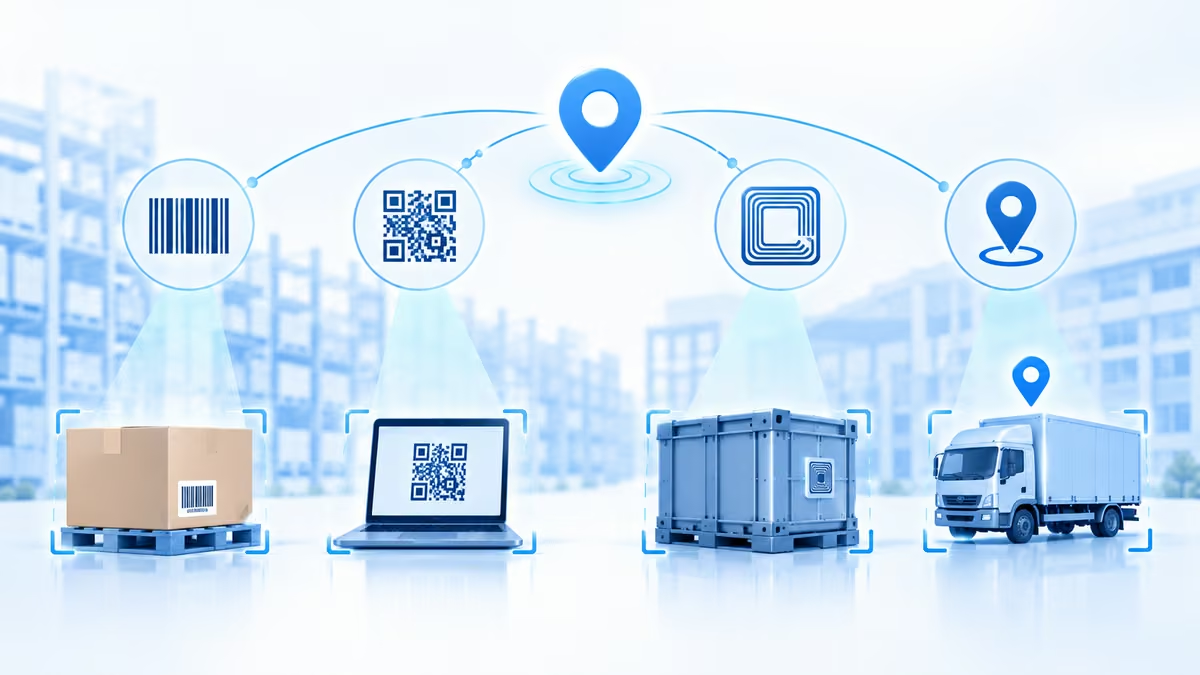
The right asset tracking technology depends on the asset. Barcodes and QR codes suit equipment that stays in one place and can be scanned by hand, RFID suits large numbers of items that need to be checked quickly, and GPS suits vehicles and other assets that travel. Many businesses use more than one.
A company can spend heavily on tracking and still struggle to find its equipment, and the cause is often a mismatch between technology and asset rather than the software. Tracking a laptop in an office, checking hundreds of boxes in a warehouse and following a delivery vehicle on the road are three different jobs. This guide explains how each technology works, where it fits and what to consider before choosing.
What Are the Main Asset Tracking Technologies?
The four technologies most businesses consider are barcodes, QR codes, RFID and GPS. The first three identify an asset and record where it is in a controlled environment such as an office, plant or warehouse. GPS follows assets as they move outdoors. They are not rivals so much as tools for different situations.
What Is Barcode Tracking and How Does It Work?
Barcode tracking gives each asset a unique printed label. An employee scans it with a barcode reader, and the system retrieves the item’s record and logs the scan, for example to confirm a location or a movement.
Barcodes have been used for decades because they are inexpensive, easy to print and simple to scan. They work well for office equipment, tools, furniture and warehouse stock. During an office audit, an employee can scan a laptop’s label and check it against company records.
The limitation is that barcodes generally need a clear line of sight and must be scanned one by one, so checking hundreds of items takes time.
What Is QR Code Tracking and How Does It Work?
QR code tracking works on the same principle, using a two-dimensional code that can hold more data and can usually be read by an ordinary smartphone camera. Employees scan a label to open the asset record, check its assigned location, report damage or update its status.
Consider a business with several branches. When equipment is transferred, the receiving employee scans its QR code and confirms the handover, with no searching through spreadsheets. Because no specialised scanner is needed, QR codes are a low-cost way to start.
Like barcodes, they need a person to scan each asset and will not report movement on their own.
What Is the Difference Between Barcodes and QR Codes?
- Data capacity: QR codes store more information than traditional barcodes.
- Scanning device: barcodes usually use a dedicated reader; QR codes can be read with a smartphone.
- Typical use: barcodes suit simple identification at scale, while QR codes suit situations where staff want to open details or update records on the spot.
- What they share: both are optical, need line of sight and are scanned one asset at a time.
What Is RFID Tracking?
RFID, or Radio Frequency Identification, uses radio waves rather than a visible code. Each asset carries a small tag, and readers detect tags that come within range. Depending on the system, several tagged items can be detected without scanning each one individually.
How Does RFID Work in Asset Management?
A typical setup has three parts: tags attached to assets, readers or antennas placed at doorways, in storage areas or carried by staff, and software that records what was detected and where. In a warehouse, a worker with a handheld reader can identify tagged equipment in an area, or a fixed reader can log items passing through a gate. That makes inventory checks and asset verification considerably faster.
RFID systems can cost more. Tags, readers, installation and supporting infrastructure all add to the investment, and performance depends on the type of system and the surrounding environment.
What Is GPS Tracking and Where Is It Useful?
GPS tracking uses satellite positioning to monitor the location of vehicles and other suitable mobile assets, usually with a device that sends its position over a mobile network. A logistics company can see where its delivery vehicles are, monitor routes and coordinate its fleet, and a business managing vehicles across several cities gets location updates without anyone scanning at every stop.
GPS devices and connectivity add recurring cost, and GPS is not suitable for every asset, particularly small indoor equipment where signals may be weak.
What Is the Difference Between RFID and GPS?
RFID identifies assets within range of a reader, so it suits controlled sites. GPS reports the position of an asset wherever it is, as long as it can receive a signal and report it, so it suits assets in transit. RFID answers “which items are in this area?”; GPS answers “where is this vehicle now?”
Indoor Versus Outdoor Asset Tracking
Environment narrows the choice quickly. Indoors, barcodes, QR codes and RFID work well because they do not depend on satellites. Outdoors and on the road, GPS is the natural fit. Assets that move between the two, such as a generator that travels to a site and returns to a store, may need a combination: GPS while in transit and QR or RFID identification at either end.
Fixed Asset Tracking and Physical Verification
Fixed assets such as computers, furniture, plant and machinery must be verified physically against the asset register, usually every year. Labels make this practical. Staff scan each asset, compare what they find with what the records say, and flag items that are missing, moved or damaged. A QR code lets the person verifying the asset open its record on a phone and confirm details on the spot.
Asset Audits and Inventory Management
The same technologies support audits and stock counts. Barcodes and QR codes suit smaller or slower audits. RFID suits large counts where manual scanning would take too long. In every case, the value comes from matching what is found physically against the records, and then correcting the records, so that figures used for accounting and planning can be trusted.
Cost and Implementation Considerations
- Hardware: barcode and QR labels are cheap; RFID needs tags, readers and often fixed installation; GPS needs a device per asset.
- Running costs: GPS typically involves connectivity charges, and tags or labels need replacing over time.
- Process: someone must label assets, scan them and fix discrepancies. Technology does not replace this discipline.
- Environment: metal, liquids, outdoor conditions and building layout can affect how well a technology performs, so test on real assets before rolling out.
- Software: identification is only useful if scans update a central record.
Which Asset Tracking Technology Should You Choose?
Here is a side-by-side comparison:
| Technology | Best Use Case | Tracking Method | Main Advantage | Limitation |
|---|---|---|---|---|
| Barcode | Office equipment, tools, furniture and warehouse inventory | Optical scan of a printed label, one item at a time | Low cost and simple to set up | Needs a clear line of sight and individual scanning |
| QR Code | General business assets, branch transfers, fixed asset audits | Scan of a 2D code with a smartphone camera or scanner | Holds more information and needs no special hardware | Still needs someone to scan each asset |
| RFID | Warehouses, factories and facilities with many assets | Radio waves between tags and readers | Faster bulk identification without scanning each item | Higher cost for tags, readers and installation; performance varies with environment |
| GPS | Vehicles and other mobile assets | Satellite location data sent over a network | Live location monitoring across cities and routes | Device and connectivity costs; unreliable indoors and unsuitable for small items |
To choose, work through these questions:
- Does the asset move, and how far?
- How often does it need to be checked or located?
- Are you tracking a few hundred items or many thousands?
- Is the asset indoors, outdoors or both?
- What budget is realistic for hardware, installation and running costs?
The best system is not the one with the most advanced technology. It is the one that fits the assets, the working environment and the budget.
How Can ERP and Asset Management Software Integrate These Technologies?
A barcode reader or RFID antenna can identify an item, but a business also needs somewhere to keep its purchase details, assigned employee, location history, maintenance records and financial information. An ERP or asset management system provides that central record. Scans and location updates feed it, and teams can then see where equipment is, how it is used and whether the records are accurate.
Bigsun’s ERP software connects purchasing, inventory, accounting and reporting, and Financial Accounting Software (FAS) covers the accounting side. If you are planning to tie asset tracking to your purchase and finance records, you can contact the Bigsun team to discuss your requirements.
Practical Examples Across Industries
- Offices and IT: QR codes on laptops and monitors make branch transfers and annual verification quicker.
- Warehousing and distribution: RFID readers at dispatch areas speed up identification of tagged equipment and stock, while barcodes cover lower-value items.
- Manufacturing: tools and machines carry barcode or QR labels linked to maintenance records. See Manufacturing ERP.
- Construction: GPS on vehicles and mobile equipment, with QR labels for tools moving between sites. See Construction ERP and our case studies.
- Logistics: GPS for fleet visibility, with scans at depots to confirm handovers.
- Healthcare: labels on clinical equipment help locate devices and confirm servicing is up to date.
Once assets are identified, the next step is using their data well. Our article on moving from reactive maintenance to asset intelligence explains how.
Final Thoughts
No single technology suits every asset. Barcodes are affordable, QR codes are convenient, RFID speeds up large-scale identification and GPS follows mobile equipment. Before choosing, look at how your assets move, how often they need to be checked and how much visibility you actually need. The smartest investment solves the problem without making asset management more complicated than it has to be.