
Your Company Doesn't Have an Asset Problem. It Has an Asset Data Problem.
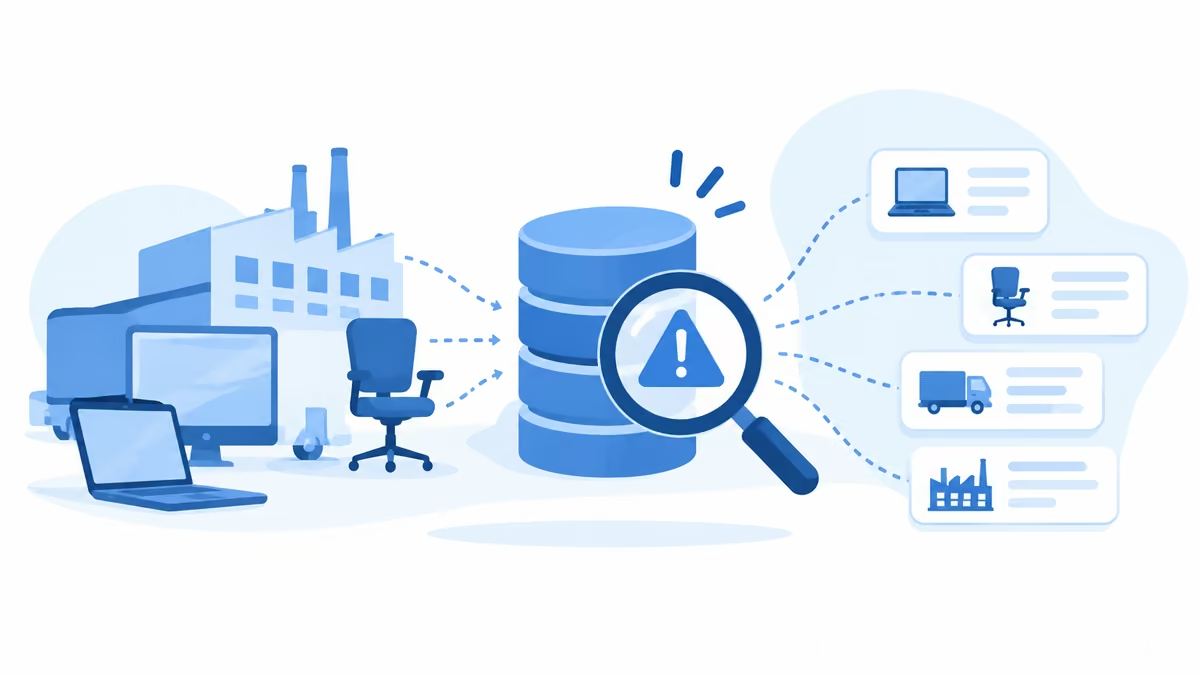
A company buys 50 new laptops. The purchase is recorded, the laptops are distributed and everything seems fine. Six months later, someone from finance asks how many are still in use. IT has one list, administration has another, and the fixed asset register shows a few laptops that nobody can immediately locate.
The company owns the equipment. The problem is that nobody has a completely reliable picture of it.
Many businesses experience this. They spend money on equipment, maintain records and run audits, yet still struggle to answer basic questions about their assets. Often the issue is not the assets themselves. It is the quality of the information around them.
That is also why asset tracking software alone rarely solves the problem. Tracking is only as good as the asset records behind it. This article explains how asset data goes wrong, and what finance, IT and operations teams should fix before choosing an asset tracking system.
Quick answer: An asset data problem occurs when asset information is missing, outdated, inaccurate or scattered across different systems. The company may own enough equipment, but it cannot reliably say where each asset is, who holds it, what state it is in or what it is worth in the books. That leads to misplaced assets, wrong depreciation, unnecessary purchases and difficult audits. The fix is one centralised, consistently maintained asset record that is updated whenever an asset changes.
What is an asset data problem?
Asset data is everything a business records about its assets: description, identification number, purchase details, cost, location, assigned employee, condition, status and depreciation. An asset data problem exists when that information is incomplete, out of date, wrong or kept in several places that do not agree with each other.
It is different from an asset shortage. A company with an asset data problem may have plenty of equipment. What it lacks is a dependable answer to simple questions such as "how many do we have?", "where are they?" and "who is responsible for them?".
How do asset records stop reflecting reality?
Asset information changes constantly. Equipment is transferred, employees leave, machines are replaced and items are sent for repair. If these changes are not recorded properly, the records slowly drift away from reality:
- A laptop still appears under an employee who left months ago.
- A machine sits in a different plant from the one listed in the register.
- An asset is marked active when it has already been disposed of.
- The same asset appears twice because two teams registered it separately.
Individually these mistakes seem minor. Together they create problems for every function that relies on asset information. The table shows who typically holds which part of the picture.
| Team | What it usually tracks | What goes wrong without a shared record |
|---|---|---|
| Finance | Cost, capitalisation date, depreciation, net block | Depreciation continues on assets that were sold, scrapped or never found |
| IT | Laptops, servers, licences, user assignments | Devices stay assigned to former employees; replacement is bought for equipment that already exists |
| Administration | Furniture, vehicles, office equipment | Transfers between floors or branches are not recorded; duplicates appear |
| Operations or plant | Machines, tools, maintenance history | Maintenance planned against the wrong asset; repeated repairs not noticed |
Why do multiple spreadsheets and disconnected systems make it worse?
For a small business, one spreadsheet may be enough. But for a company with several branches, factories, warehouses and thousands of assets, enterprise asset management becomes far more complicated. Finance tracks values, IT manages computers, administration handles office equipment and operations looks after machinery, each in its own file or system.
The difficulty is getting everyone to work with the same information. Without a centralised process, departments end up with conflicting records. A change made by one team may never reach another. When asset information is stored in multiple spreadsheets, teams work with conflicting records, which makes verification and reporting hard. If this sounds familiar, our article on what your CFO can't see in a spreadsheet-based fixed asset register looks at the same issue from the finance side.
What does poor asset data cost a business?
Poor asset information does not only create administrative confusion. It affects money, operations and compliance.
Inaccurate asset valuation and depreciation
Depreciation depends on an asset's cost, useful life, residual value and the date it became available for use. If any of these details are wrong, depreciation and net block figures are wrong too. Assets that no longer exist but remain in the register keep inflating the books. The effect of bad inputs is explained in why depreciation accuracy starts before the asset reaches finance.
Maintenance and operational inefficiencies
Operations teams rely on asset records to plan servicing and repairs. If a machine's location or history is wrong, maintenance may be scheduled against the wrong unit, or repeated repairs on the same equipment may go unnoticed. Management might also buy extra equipment without realising that suitable assets are sitting unused in another location. That is how "unnecessary purchases" happen in a company that already owns enough.
Financial reporting and audit risks
Reports are only as reliable as the information behind them. Incorrect asset values, locations and statuses lead to misleading reports and poor decisions, and poor asset data can result in inaccurate depreciation calculations and balance sheet figures. Incomplete data also makes physical verification difficult and raises the risk of discrepancies surfacing during audit, when they are most expensive to resolve.
How does asset verification expose the problem?
One of the simplest ways to find an asset data problem is asset verification: physically checking assets and comparing what is found against the register.
For example, an employee visits an office with a list of 100 recorded assets. During the check, they find that five items have been moved, two cannot be located and three are no longer in use. Each of these differences must be investigated and corrected, and each shows a place where the records and reality had separated.
Verifying assets regularly helps identify missing equipment, wrong locations, duplicate records and outdated information before these issues affect audits or financial reporting. For a deeper look at this reconciliation, see The Asset Nobody Can Find.
How can companies build a reliable asset data system?
Companies often respond to asset problems by buying more equipment, running more audits or asking employees to update spreadsheets. These steps do not help much if the underlying information stays unreliable. A better starting point:
- Give every asset one record. Each asset needs a unique identification number, a known location and a clear status.
- Centralise the records. Keep asset information in one place that finance, IT, administration and operations all use.
- Standardise data entry. Use the same categories, naming and mandatory fields everywhere.
- Track movements as they happen. Record transfers, repairs, replacements and disposals when they occur, not at year-end.
- Review regularly. Check for missing information, duplicates and outdated details, and run physical verification at planned intervals.
- Assign ownership. Decide who is responsible for keeping each class of asset data correct.
None of this requires a company to collect endless amounts of data. What matters is collecting the right information and keeping it current.
How does asset tracking and asset management software improve data reliability?
A good asset tracking and asset management solution should make accurate record-keeping easier, not add another layer of administrative work. Fixed asset management software can help businesses keep a central database containing:
- Asset descriptions, identification numbers and purchase details.
- Current locations and assigned employees.
- Transfer, repair and disposal records.
- Depreciation details and financial values.
- Physical verification results and discrepancies.
- Reports on asset distribution and utilisation.
When information is updated regularly, different teams see a more consistent view of company assets. Automation can also reduce the chance of forgetting an update: recording a transfer can change the assigned location instead of leaving the old information untouched. Our complete guide to fixed asset management software explains the capabilities to look for.
Bigsun's Financial Accounting Software (FAS) and ERP software are built to keep accounting and operational records connected. If you want to see how your own asset records could be handled, you can get in touch with the team.
What should finance, IT and operations leaders ask?
If you suspect an asset data problem in your own business, these questions can help you test it:
- CFO or finance head: When did we last compare the register with physical assets, and what differences did we find?
- IT head: Can we list every device and who currently holds it, without checking three files?
- Operations manager: Does the maintenance history sit against the correct asset and location?
- Everyone: When an asset moves or is disposed of, who updates the record, and how soon?
Better decisions begin with better information. When asset data is accurate, management can spot underused equipment, investigate repeated maintenance costs, plan replacements and avoid unnecessary purchases. Finance teams work with more dependable records, and auditors can verify information with less back and forth.
Final thoughts
The first step is making sure every asset has an accurate record, a known location and a clear status. When a company understands the information behind its assets, it can manage those assets with far greater confidence. That is where effective fixed asset accounting and control really begin.
If you are shortlisting asset tracking software or fixed asset management software, begin by checking how it keeps records accurate after the first upload. Talk to the Bigsun team about how FAS and ERP could keep your asset records connected.
Bring your asset information together
If your asset records are spread across finance, IT, administration and plant files, talk to the Bigsun team about keeping them on one connected system.