
How AI Is Transforming Quality Control in Manufacturing
Imagine buying a new product only to discover that a part is broken or something does not work as expected. For manufacturers, even a small defect can lead to unhappy customers, wasted materials, and costly rework. That is why quality control is such an important part of the manufacturing process.
Traditionally, workers have checked products manually to make sure they meet quality standards. While this approach is still valuable, inspecting thousands of products can be tiring and time-consuming. This is where artificial intelligence (AI) is making a difference.
AI in manufacturing quality control helps businesses spot defects faster, improve consistency, and deliver better products. Quality results are easier to act on when they sit alongside production data in a Manufacturing ERP. Let’s look at how this technology works and why it matters.
Why Quality Control Matters
Quality control is about making sure products meet the required standards before they reach customers. A factory producing car parts, for example, needs to ensure that every component is safe and fits correctly.
When defects go unnoticed, manufacturers may have to repair or replace products, throw away materials, or deal with customer complaints. In industries where safety is important, poor quality can have even more serious consequences.
Good quality control helps businesses avoid these problems. AI-powered quality control makes the process more efficient by helping workers identify issues earlier and more consistently.
How AI Is Changing Quality Inspection
1. Spotting Defects More Quickly
Imagine checking hundreds of bottles on a production line to find those with cracks, damaged labels, or incorrect caps. Doing this manually can be difficult, especially when products move quickly.
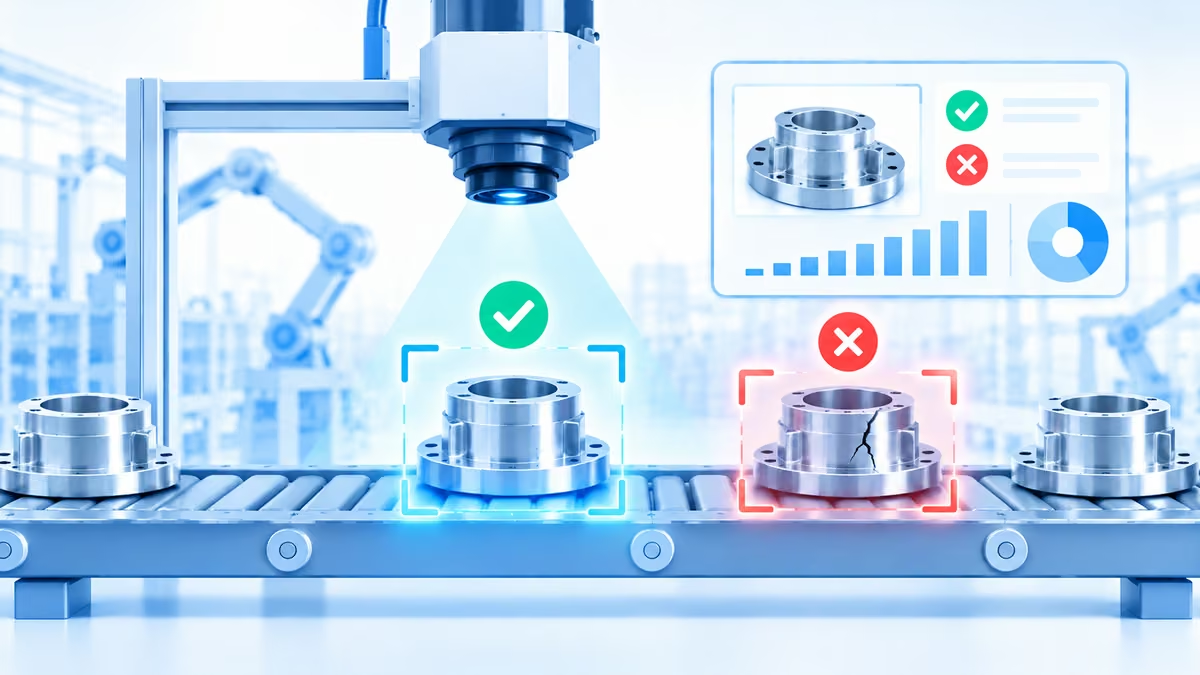
AI for quality inspection uses cameras and image recognition to examine products as they pass through a production line. The system can flag visible defects, such as scratches, dents, missing parts, or uneven surfaces.
This helps manufacturers inspect more products in less time while allowing workers to focus on problems that need closer attention.
2. Improving Inspection Accuracy
People can become tired or distracted when performing repetitive tasks for long periods. This may cause small defects to go unnoticed.
AI-based quality inspection can apply the same inspection rules consistently across large numbers of products. It can help identify differences that might be difficult to notice during a quick visual check.
However, AI is not perfect. Its performance depends on the quality of its training data, the inspection setup, and the type of defect it needs to detect. Human oversight remains important.
3. Finding Problems During Production
Finding a defect after a product has been fully assembled can be expensive. Manufacturers may need to dismantle the product, replace parts, or repeat several production steps.
AI manufacturing inspection can help detect quality issues while products are still being made. For example, if a machine repeatedly produces parts with the wrong dimensions, an AI system may identify the pattern and alert the team.
Addressing the issue early can reduce waste and prevent the same mistake from affecting hundreds of products.
4. Understanding Why Defects Occur
AI can do more than identify faulty products. It can also help manufacturers understand what might be causing the problem.
By comparing inspection results with machine settings, production records, and environmental conditions, AI systems can uncover patterns linked to recurring defects.
For example, a manufacturer might discover that certain defects appear more frequently when a machine operates at a particular temperature. This information helps the team investigate the cause and make improvements.
Key Benefits of AI Quality Control in Manufacturing
AI offers several practical advantages:
- Less waste: Detecting defects early helps reduce the number of unusable products.
- Lower costs: Fewer defective items mean less rework and fewer replacements.
- Faster inspections: Automated systems can examine products quickly.
- Consistent quality: AI helps apply inspection standards across production runs.
- Better decisions: Production data helps teams identify recurring problems and improve processes.
How Manufacturers Can Get Started
Businesses do not need to automate every inspection at once. They can begin with one production line or a product that frequently develops defects.
The next step is to collect suitable images and production data, choose an AI inspection solution, and test how well it identifies known defects. Workers should review the results and help improve the system over time.
Starting small allows manufacturers to understand the benefits before expanding AI quality control to other parts of the factory.
For related reading, see how ERP automation helps minimize quality costs, and read the manufacturing and distribution ERP case study to see how one business runs operations on a single platform.
Final Thoughts
Quality control has always been essential to manufacturing, but checking every product manually can be challenging as production grows.
AI in manufacturing quality control gives businesses another way to identify defects, reduce waste, and maintain consistent standards. By combining AI inspection tools with human experience, manufacturers can catch problems earlier and make better decisions.
AI may not eliminate every defect, but it can help businesses build a more reliable quality control process and deliver products that customers can trust.
Want quality, production and inventory data in one place? Explore Bigsun Manufacturing ERP or contact our team to discuss your plant.
Related Reading
- AI-Powered Defect Detection: The Future of Quality Inspection
- How AI Helps Reduce Manufacturing Defects and Rework
- How Computer Vision Helps Manufacturers Detect Product Defects