
How AI Helps Reduce Manufacturing Defects and Rework
What if you spent hours making a product, only to find a fault just before delivery? The unit has to be opened, corrected, re-tested and repacked, or sometimes thrown away. The order is late, the material is gone and the team has done the same work twice.
These situations are familiar to almost every plant head and quality manager. The encouraging part is that many of them can be prevented. Artificial intelligence (AI) helps manufacturers reduce manufacturing defects and rework by finding problems sooner, revealing why they repeat and giving teams the information needed to correct the process rather than only the product.
This article covers where defects come from, what rework really costs, how AI helps at each stage and how Manufacturing ERP software keeps quality actions connected to production.
Understanding Defects and Rework
A manufacturing defect is any way in which a product differs from its specification: a crack, a dimensional error, a wrong colour, a missing part, a weak weld or an incorrect label. Rework is the extra effort to bring a non-conforming product back to standard so it can be sold. Units that cannot be recovered become scrap.
The hidden cost of poor quality
Quality professionals often group these costs under the “cost of poor quality”. It includes obvious items such as scrap and repair labour, and less obvious ones:
- Extra inspection and re-testing
- Machine time used to reprocess instead of producing new units
- Expedited freight and overtime to recover delays
- Customer returns, replacements and warranty handling
- Management time spent in investigations and meetings
- Lost goodwill when a faulty product reaches a customer
Because many of these costs are scattered across departments, plants often underestimate the total. Tracking them in one place is the first step to seeing the problem clearly.
What Causes Manufacturing Defects?
Defects tend to come from a small set of root-cause families, often described as the “5M”:
- Machine: wear, drift, poor calibration, tooling issues.
- Material: out-of-spec supplier lots, moisture, contamination.
- Method: unclear work instructions, wrong parameters, process steps skipped.
- Man (people): training gaps, fatigue, handover mistakes.
- Measurement: faulty gauges, inconsistent inspection standards.
Often it is a combination: a slightly worn tool, a slightly different material lot and a new operator. That interaction is difficult to see from paper records, and it is where data analysis adds real value.
How AI Helps Reduce Manufacturing Defects
1. Finding defects earlier
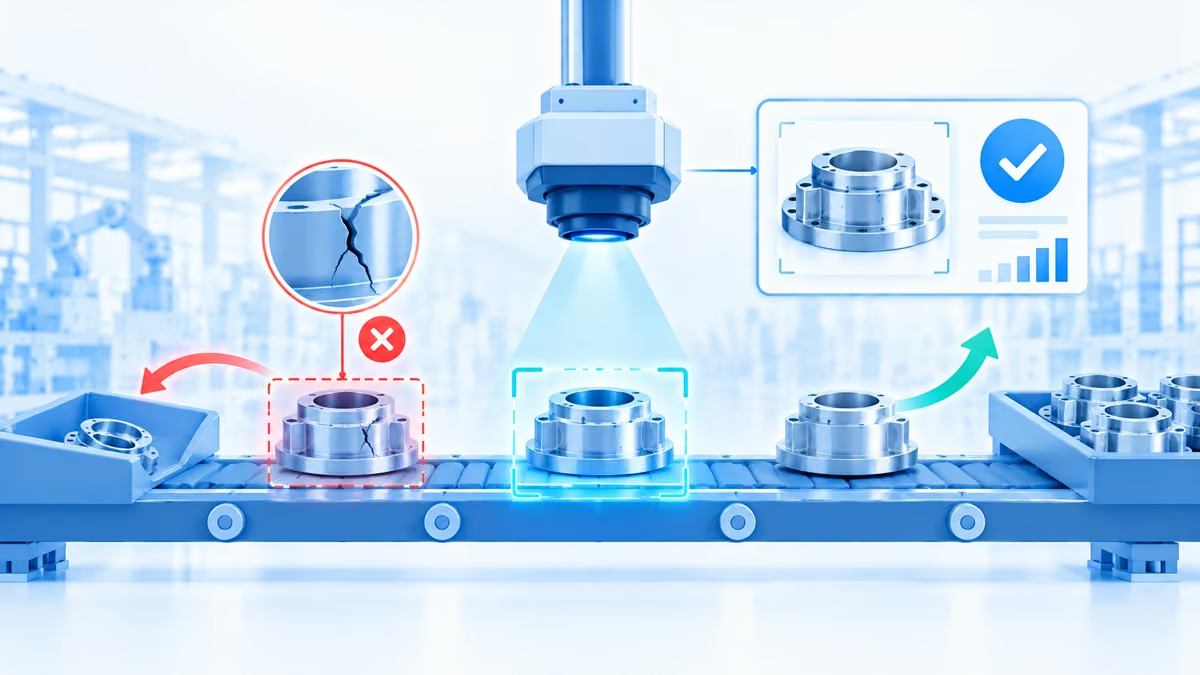
The later a defect is found, the more it costs, because more material, time and processing have been invested in the unit. AI-based visual inspection can examine products during production and flag issues such as scratches, cracks, dents, missing parts or incorrect assembly while the product is still on the line. Our article on AI-powered defect detection and the dedicated guide to computer vision for defect detection explain how this works.
2. Spotting repeat problems
If the same defect keeps returning after every repair, the repair is not addressing the cause. AI can study inspection results alongside machine data, shift patterns, material lots and maintenance records to find combinations that appear together. For example, a plant might notice that a surface defect rises whenever one die is used with one supplier’s material. That is a lead for engineers, who then confirm the cause and decide the corrective action. See also AI for root cause analysis in manufacturing.
3. Making inspection more consistent
When people inspect hundreds of units per shift, small defects can be missed and borderline cases may be judged differently by different inspectors. Automated checks apply the same criteria to every unit. They still need good training examples, regular testing and human review, because no system is perfect, but they can make inspection results more uniform.
4. Linking process conditions to quality
Many defects are caused by process conditions that drift: temperature, pressure, speed, humidity or tool wear. AI can relate these readings to quality outcomes and indicate when a process is moving toward the zone where defects become likely. Operators and engineers can then adjust settings before out-of-spec units appear. This connects closely with reducing unplanned downtime, because machine health and product quality often deteriorate together.
5. Prioritising what to fix first
Quality teams are rarely short of problems; they are short of time. Ranking defects by frequency and cost (a Pareto analysis) shows where effort will return the most. AI-assisted reporting makes that ranking quick to refresh, so priorities follow current data instead of last quarter’s meeting.
An Illustrative Example
Consider a hypothetical plant that makes plastic housings for electrical products. Each week about one in twenty housings is reworked for surface marks. Operators sand and re-inspect them, which takes time and sometimes still ends in rejection.
The quality team starts logging every rework event with the machine, mould, shift and material lot. After a few weeks the data shows that most marks come from one mould on the night shift. Comparing mould maintenance and drying records reveals that this mould is cleaned less often and that the material from one lot was loaded without the full drying time. Engineers confirm the finding on the floor, adjust the cleaning interval, add a drying check to the start-up checklist and track the result.
No single step here needed advanced technology, but AI-assisted analysis makes this kind of discovery faster when there are dozens of machines, moulds and lots, and the ERP record of batches and maintenance is what makes the comparison possible. The figures in this example are invented purely to illustrate the method, not to suggest typical results.
Where Manufacturing ERP Fits
Detecting a defect is only useful if the information reaches the right people and leads to action. ERP is where quality events meet production, inventory and purchasing.
- Traceability: tie each defect to the work order, machine, batch and raw material lot.
- Rejection and rework booking: record quantities, reasons and value so the real cost is visible.
- Supplier feedback: link incoming material problems to purchase orders and vendors.
- Approvals and follow-up: route corrective actions to owners and track them to closure.
- Reporting: view defects and rework by product, line, shift and period.
Bigsun Manufacturing ERP connects production planning, plant maintenance and inventory, giving a single record of what was made, on what, and by whom. Where you use AI inspection or analytics tools, Bigsun’s APIs and integrations can help connect their results with your ERP data, subject to your systems and requirements. Our article on how AI-powered ERP is changing manufacturing management and the overview of AI-powered quality management offer more background.
A Practical Approach to Cutting Rework
Step 1: Make rework visible
Many plants do not record quick repairs done at the workstation. Start by logging every rework event with the defect type, quantity, time taken and station. You cannot reduce what you do not measure.
Step 2: Focus on the vital few
Rank defect types by cost. A handful usually account for most of the loss. Pick one or two for a focused improvement effort.
Step 3: Choose the matching AI use
- Visible surface or assembly defects: image-based inspection.
- Defects with unclear causes: analysis across machine, material and shift data.
- Defects linked to wear or drift: process and machine monitoring.
Step 4: Pilot, compare and keep humans in the loop
Run a pilot on one line. Compare defect rates and rework hours with the earlier baseline, and run the existing manual checks alongside until the team trusts the alerts. Train employees to understand what each alert means and what to check first.
Step 5: Turn learning into standards
When a cause is confirmed, update work instructions, set-up parameters, supplier specifications or maintenance schedules so the fix lasts. Corrective and preventive actions recorded in the system become institutional knowledge rather than individual memory.
Step 6: Expand carefully
Only extend to further lines when the pilot shows measurable results. Use business process automation to standardise approvals and follow-ups as the programme grows.
Key Benefits of Using AI for Quality Assurance
- Lower production costs: less money spent on repairs and replacement materials.
- Less waste: problems caught before additional resources are used.
- Faster production: less time spent correcting avoidable mistakes.
- Better product quality: consistent checks maintain standards.
- Fewer customer complaints: faulty units are more likely to be caught before delivery.
What to Watch Out For
- Training data matters. A model that has not seen examples of your real defects may miss them.
- Conditions change. New materials, products or lighting may require re-testing.
- Do not hide rework. Pressure to show low defect numbers can discourage honest recording.
- Treat AI findings as leads. People who know the process confirm the cause.
Final Thoughts
Manufacturing defects and rework are expensive, but many of them become manageable once they are found early, traced to their causes and recorded properly. AI helps by catching faulty units, exposing repeat patterns and supporting better process decisions, while ERP keeps the data connected from purchase to dispatch. Combined with the experience of your own people, this gives manufacturers a realistic path to less waste, controlled costs and more consistent quality.
If you want to see how quality, production and inventory records can work together, explore Bigsun Manufacturing ERP or speak with our team. You may also like our guide on how AI can improve first-pass yield in manufacturing.