
Using AI to Reduce Unplanned Downtime in Manufacturing
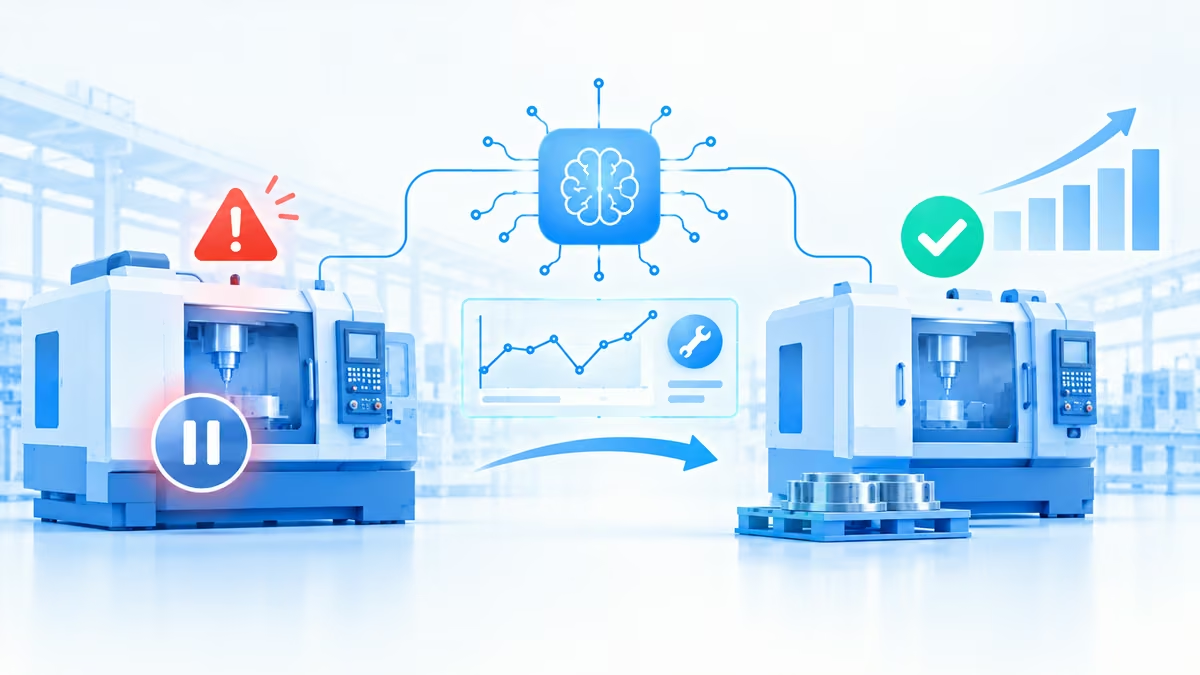
Picture a busy factory where everything is on schedule. Orders are moving, operators are in rhythm and the dispatch plan looks achievable. Then a key machine stops. Nobody planned for it, spare parts are not at hand, and every job queued behind it begins to slip.
That is unplanned downtime in manufacturing, and it is one of the most disruptive events on a shop floor. Unlike a scheduled shutdown, it arrives without warning, at whatever moment the machine chooses. The good news is that many breakdowns give early signals before they happen. AI-based monitoring is designed to notice those signals and turn them into a maintenance plan rather than an emergency.
This article explains why unplanned downtime is so costly, how AI predictive maintenance works in plain terms, and how connecting it with Manufacturing ERP software helps you act on warnings instead of just receiving them.
Why Unplanned Downtime Costs More Than It Appears
The obvious cost of a breakdown is the repair itself. The larger cost is usually everything around it:
- Lost production time: the machine is idle, and often the operators and downstream stations are idle too.
- Delayed orders: customer commitments slip, and expediting costs rise.
- Scrap and restart losses: material in process may be spoiled, and the restart period often produces off-spec units.
- Rushed repairs: emergency spares, overtime and urgent vendor calls cost more than planned work.
- Knock-on damage: a small fault left running can damage connected parts, turning a minor repair into a major one.
- Safety exposure: hurried interventions on live equipment increase risk.
A first useful step is to simply measure it. For each major machine, record how often it stops unexpectedly, how long each stop lasts, and the reason. Many plants are surprised to find that a few machines or a few repeat causes account for most of the lost hours.
Common Causes of Unplanned Downtime
Before choosing technology, it helps to know what you are solving. Typical causes include:
- Worn bearings, belts, seals and tooling that were not replaced in time
- Lubrication problems, overheating and contamination
- Electrical faults, loose connections and power quality issues
- Operator errors or incorrect machine settings
- Poor-quality or wrong raw material causing jams and stoppages
- Missing spare parts when a fault is found
- Maintenance tasks skipped, delayed or not recorded
Notice that not all of these are predictable by a sensor. Some are process or planning issues. AI helps most with the wear-related and condition-related causes, while good ERP discipline helps with the planning-related ones. A sound programme uses both.
From Preventive to Predictive Maintenance
Run-to-failure and preventive maintenance
The simplest approach is to run a machine until it fails. It requires no planning but gives the worst downtime. Preventive maintenance improves on this by servicing machines on a fixed calendar or run-hour schedule. It helps, but it has two weaknesses: it may service parts that are still healthy, wasting time and spares, and it can still miss a part that wears out earlier than the schedule assumed.
Predictive maintenance
Predictive maintenance bases the decision on the actual condition of the machine. Sensors collect readings such as temperature, vibration, pressure, current and speed. AI models learn what normal looks like for that machine under different loads and products, and raise an alert when behaviour drifts in a way that has previously preceded trouble. Maintenance can then be scheduled for a convenient window before the failure occurs. If you want a broader introduction to the analytics behind this, see our article on what predictive analytics is.
How AI Helps Reduce Manufacturing Downtime
1. Spotting early warning signs
Machines rarely go from perfect to broken in an instant. A motor may run a few degrees hotter week after week. A gearbox may develop a vibration pattern that is invisible to the ear but clear in the data. AI can analyse sensor streams and maintenance history to catch these slow changes that routine walk-around inspections can miss.
2. Monitoring around the clock
Nobody can watch every machine on every shift. Automated monitoring does not get tired and does not skip the night shift. It can send an alert to the right supervisor or technician when a reading crosses a threshold or a pattern looks unusual.
3. Timing maintenance sensibly
Servicing too early wastes parts and labour; servicing too late risks a breakdown. Condition-based data lets planners find a better balance and place repairs in natural gaps such as changeovers, planned stops or low-demand periods.
4. Finding the root cause of repeat failures
If the same machine keeps failing after every repair, the repair is probably treating a symptom. Looking across breakdown history, operating conditions, spare part batches and operator changes can show what is common to the failures. Our guide to AI for root cause analysis in manufacturing covers this approach in more depth.
5. Connecting downtime with quality
A machine that is about to fail often produces worse output first. Linking maintenance alerts with inspection results helps you stop a drifting machine before it creates defects, which supports your first-pass yield.
The Role of ERP in Reducing Downtime
Detecting a problem is only half the job. Someone must raise the work, find the spare part, free the machine, assign the technician and record what was done. This is where ERP does its work.
- Equipment master and history: every machine with its age, location, past breakdowns and costs.
- Maintenance scheduling: planned and condition-triggered jobs with owners and due dates.
- Spare parts inventory: the part needed for the predicted repair is in stock, or ordered in time.
- Production planning: repairs are placed where they cause the least disruption to the schedule.
- Reporting: downtime hours, repeat failures and maintenance cost by machine, line and period.
Bigsun Manufacturing ERP brings production planning, plant maintenance and inventory together in one system, so a maintenance decision can be made with a view of both the production plan and the spares position. For a closer look at maintenance tools, you can read our overview of the best plant maintenance software in India. If your machines or monitoring tools already generate data, Bigsun’s APIs and integrations can help bring that information alongside your ERP records. What is possible depends on the equipment and systems at your site, so it is worth discussing with our team.
How to Start: A Practical Roadmap
Step 1: Identify your critical machines
Not every asset deserves sensors. Start with machines that are single points of failure, expensive to repair, long to restore or that sit in the middle of your flow. A short criticality ranking is enough.
Step 2: Fix the basics of record keeping
Record every stoppage with a start time, end time and a cause code that people actually use consistently. Without this, you cannot prove improvement later. The ERP maintenance module is a natural home for these records.
Step 3: Choose what to monitor
Match the measurement to the failure mode. Rotating equipment often benefits from vibration and temperature monitoring; hydraulic systems from pressure and oil condition; electrical drives from current and temperature. Ask your maintenance team which signals they currently watch by feel or by sound, and start there.
Step 4: Run a pilot and compare
Pilot on a small group of machines for a defined period. Compare unplanned stoppages and repair costs against the same machines’ earlier history. Keep traditional checks in place until you trust the alerts.
Step 5: Build the response process
Decide who is notified, how fast they must respond, what is checked first and how the job is closed. An alert with no owner is just noise. Structured approvals and workflow in the ERP, supported by business process automation, help keep this disciplined.
Step 6: Scale what works
Extend to further machines only after the pilot shows value. Re-train or re-tune models when products, loads or equipment change.
Limits and Realistic Expectations
It is worth being clear about what AI cannot do. It cannot predict every failure, especially sudden ones such as a power surge or an accidental impact. Predictions depend on sensor quality, enough history of both healthy and failing behaviour, and regular tuning. False alarms can occur and need to be handled sensibly. Older machines may need retrofitted sensors. None of this is a reason to avoid the approach, but it is a reason to start small, measure honestly and keep experienced maintenance engineers in charge of decisions.
Can Smaller Manufacturers Benefit?
Yes, with a proportionate approach. A smaller plant may not need a complex AI platform on day one. Disciplined downtime recording, a clear preventive schedule and spare-parts planning in the ERP already remove a large share of avoidable stoppages. Condition monitoring on two or three critical machines can then be added once the basics are working.
Final Thoughts
Unplanned downtime is expensive because it is unplanned. AI turns hidden warning signs into early alerts, and a connected ERP turns those alerts into scheduled, resourced and recorded maintenance. The result is not a factory that never stops, but one where stops are mostly chosen rather than imposed.
To see how maintenance, spares and production planning can work together at your plant, explore Bigsun Manufacturing ERP or contact our team. You may also be interested in our article on how computer vision helps manufacturers detect product defects.